

1
Sign in to the dashboard
Go to dashboard.bloklake.com and sign in with Google,
GitHub or email. Signing in creates your account and a personal project.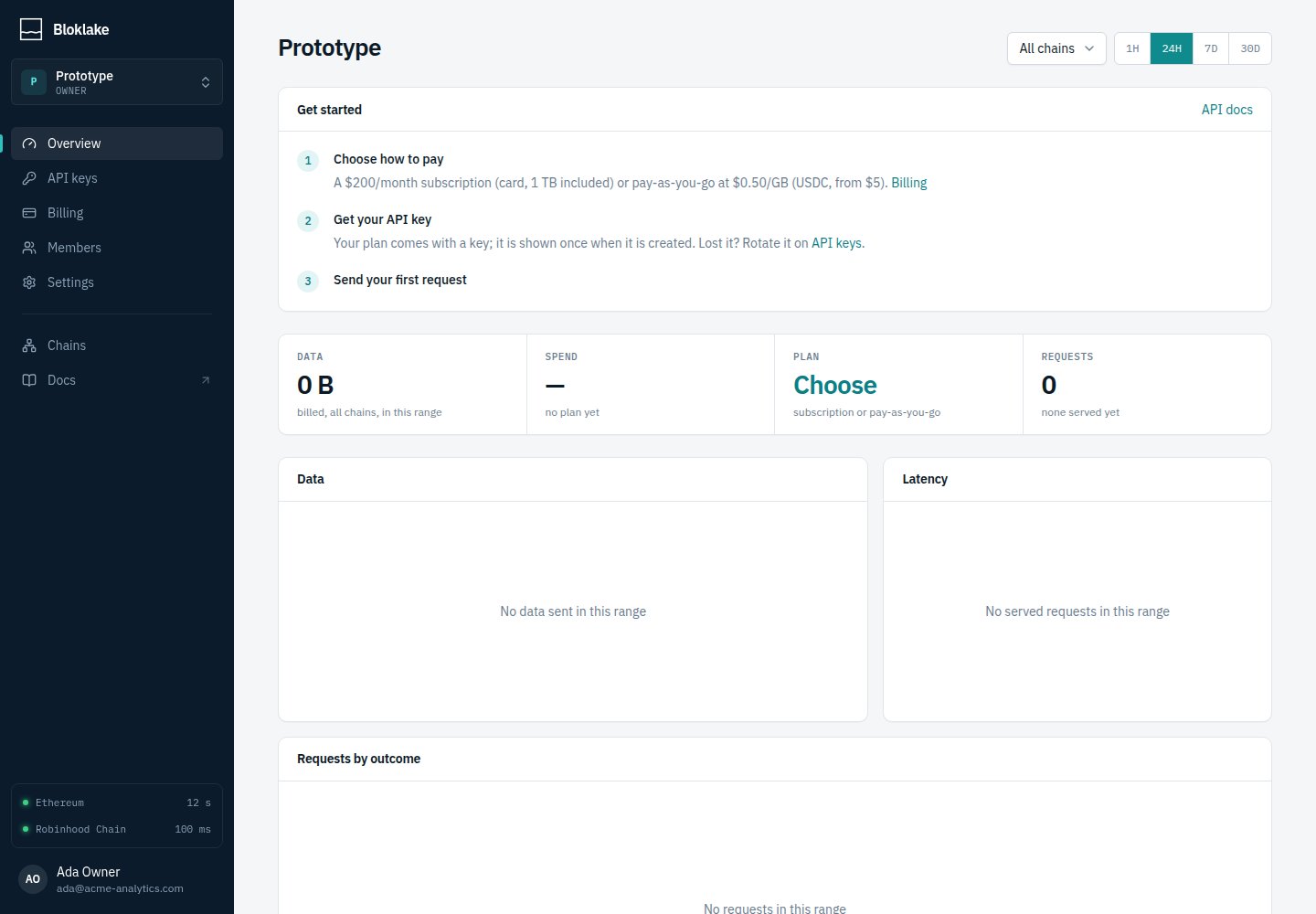
2
Choose how to pay
Open Billing and pick one:
- Pay-as-you-go: $0.50 per GB of data, prepaid in USDC from $5. Good for trying things out and for small or bursty workloads.
- Standard: $200 per month with 1 TB of data included and 10 requests per second.
3
Copy your API key
Your plan comes with an API key. It is shown once, when it is created. Copy it and keep it
in a secret store or an environment variable:Lost it? Rotate the key on API keys to get a new one. See API keys.
4
Make your first request
Every USDC transfer in ten Ethereum blocks, as JSON:The response is one JSON object: the rows under
logs, plus metadata about the range it
covers.5
Use a client library for real workloads
/query/json is for trying things out. For anything bigger, use one of the official
client libraries. They send the same query to /query, which returns the rows as
Apache Arrow: about 2–2.5× smaller than JSON, so 2–2.5× cheaper. The client decodes it back
into JSON rows for you, and handles pagination, retries and truncated responses.Next steps
Build a filter
Addresses, topics, senders, function selectors, and how they combine.
Client libraries
Paging, retries, types and errors in TypeScript, Python and Rust.
Page through a large range
The
next_block loop every client needs.Index ERC-20 transfers
A complete backfill, end to end.
Production checklist
Retries, rate limits, reorgs and cost.